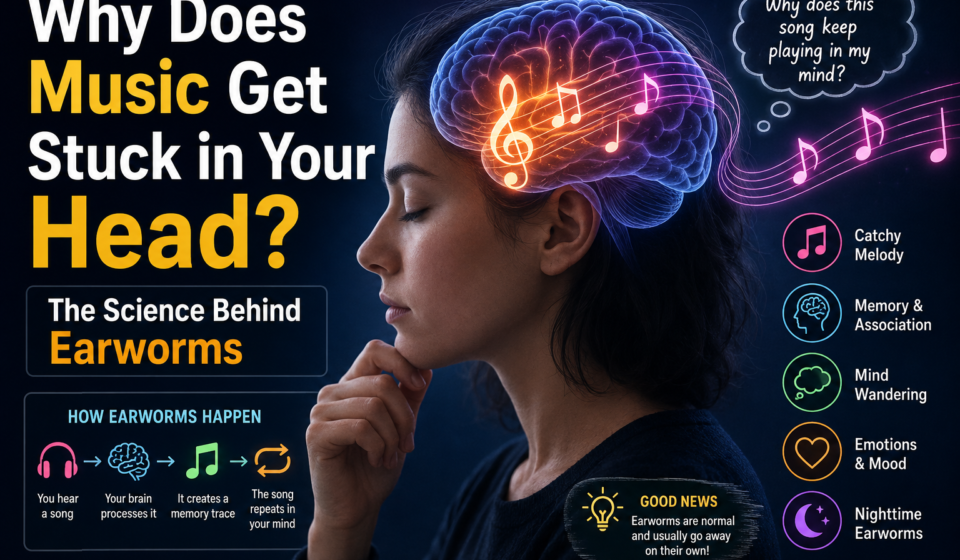

Have you ever heard a song in the morning, gone about your entire day, and then found yourself playing the same chorus in your head hours later?
You are not alone.
That catchy melody can replay in your mind even when you are not trying to remember it. Scientists call this involuntary musical imagery (INMI). Most people know it by a much simpler name: an earworm.
The strange part is that there is no music playing around you.
Your brain is creating the experience on its own.
What Is an Earworm?
An earworm is a piece of music that suddenly comes to mind and keeps repeating without you deliberately choosing to think about it.
It is usually not the entire song. Instead, your brain may replay a chorus, hook, lyric, rhythm, or short melody.
Earworms are considered a common part of everyday mental activity. They are not, by themselves, a sign that something is wrong.
You might experience one while taking a shower, driving to work, cleaning the house, exercising, or simply scrolling through your phone.
In each case, your brain is bringing a musical memory back into your awareness.
Why Does Music Get Stuck in Your Head?
There is no single reason why a song becomes an earworm.
Several things can play a role, including memory, attention, emotion, recent exposure, and mind-wandering.
1. You Heard the Song Recently
This is probably the easiest explanation.
You hear a song on the radio, TikTok, YouTube, at the gym, in a store, or from someone else’s phone. You may barely notice it.
Then, several hours later, the melody suddenly returns.
Your brain has already processed and stored enough of the musical pattern to reproduce part of it later. Repeated exposure can make this effect even stronger.
That is why a song you have heard several times can suddenly start playing in your head when you least expect it.
2. Catchy Music Is Easy for the Brain to Repeat
Some songs are incredibly memorable.
A strong chorus, repetitive rhythm, distinctive melody, or simple musical pattern can give your brain something easy to reconstruct.
However, researchers still do not have a complete answer to one important question: what exactly makes a song more likely to become an earworm?
The phenomenon is well documented, but the precise reasons certain melodies become mentally “sticky” are still being studied.
So, while scientists understand many parts of the process, there is still more to discover.
3. Your Brain May Be Mind-Wandering
Earworms do not always appear when you are fully focused on something.
In fact, they can show up when you are doing familiar activities that require little mental effort.
Think about taking a shower, walking, washing dishes, driving a familiar route, or folding clothes.
Your body is busy, but your mind has some spare attention.
During these quieter moments, thoughts and memories can surface more easily. Research has linked involuntary musical imagery with mind-wandering and spontaneous thought.
That may explain why your brain sometimes seems to start its own private concert when nothing else requires your full attention.
4. Memories and Emotions Can Trigger a Song
Music has a powerful connection with memory and emotion.
A particular song might remind you of:
- A person
- A holiday
- A movie
- A relationship
- A childhood memory
- A particular place
- A specific period of your life
Sometimes you know exactly what triggered the song.
Other times, the connection is much harder to notice.
You might see a particular word, hear a familiar sound, visit a certain place, or experience a particular mood. Suddenly, a melody appears in your mind.
Your brain does not store music in complete isolation. Musical memories can become connected with people, places, emotions, and experiences.
That is one reason a seemingly random song can suddenly feel very familiar.
Why Does the Same Part of a Song Keep Repeating?
This is often the most frustrating part of an earworm.
You may not mentally hear the entire song. Instead, your brain gets stuck on a small section.
For example, you might reach the end of a catchy chorus in your head. Instead of moving to the next verse, your brain jumps back to the beginning.
Then it happens again.
And again.
And again.
Repetition is one of the defining features of involuntary musical imagery. The brain can keep reconstructing the same musical fragment without any conscious decision from you.
It is almost like your mind has opened a browser tab and forgotten where the close button is.
Why Are Some Songs More Likely to Get Stuck?
Not every song becomes an earworm.
Researchers have investigated musical characteristics that may make certain songs more memorable. Familiarity, distinctiveness, repetition, and easily remembered musical patterns can all play a role.
Interestingly, you do not even have to like the song.
A song you dislike can become stuck in your head just as easily as one of your favorites.
That can make an earworm particularly annoying. Your brain is not necessarily asking whether you approve of the song.
It only needs a memorable pattern that it can bring back to mind.
Can Your Mood Affect Earworms?
Your emotional state may influence how noticeable or annoying an earworm feels.
A song playing in your mind might seem harmless when you are relaxed. The same melody can become extremely irritating when you are trying to work, study, or fall asleep.
People also differ in how often they experience earworms and how much they are bothered by them.
Some people barely notice them. Others experience them frequently.
That difference does not automatically mean one person’s brain is healthier than another’s. Individual differences in attention, memory, habits, and emotional response can all influence the experience.
Why Do Songs Get Stuck in Your Head at Night?
Nighttime can be the perfect environment for an earworm.
You turn off the lights, put your phone away, and finally have a quiet moment.
Then your brain suddenly remembers that chorus.
When there are fewer external distractions, your attention can turn inward. That may make a song playing in your mind feel much more noticeable.
Research has also linked frequent nighttime earworms with poorer sleep quality. Some experimental research suggests that certain listening conditions can increase the likelihood of experiencing an earworm during the night.
So, if a chorus starts looping just as you are trying to fall asleep, you are certainly not the only person who has experienced it.
How to Get a Song Out of Your Head
An earworm usually disappears on its own. However, there are a few things you can try if a song is becoming distracting.
Finish Listening to the Song
One approach is to listen to the entire song deliberately.
The idea is straightforward. Instead of allowing your brain to replay a small unfinished section, you give it the complete musical sequence.
This does not work for everyone, but some people find that finishing the song helps break the loop.
Change Your Focus
You can also give your attention to something completely different.
Try:
- Reading a few pages of a book
- Having a conversation
- Solving a puzzle
- Doing a task that requires concentration
- Going for a walk
- Listening to something different
The goal is not to fight the song aggressively.
Instead, give your brain another activity to process.
Stop Checking Whether It Is Gone
This sounds strange, but constantly asking yourself, “Is the song still in my head?” can keep your attention focused on it.
If the melody is harmless, try acknowledging it and returning your attention to whatever you were doing.
Sometimes the easiest way to stop noticing an earworm is to stop monitoring it.
Are Earworms a Sign of a Mental Health Problem?
Usually, no.
For most people, getting a song stuck in their head is a normal experience.
However, ordinary earworms are different from musical hallucinations or severe, persistent musical experiences that cause significant distress.
Those experiences can have different causes and may require professional evaluation, particularly if they are persistent or occur alongside other concerning symptoms.
An occasional catchy chorus is generally nothing to worry about.
Can You Prevent an Earworm?
There is no guaranteed way to prevent every earworm.
However, being aware of common triggers may help you understand when they are more likely to happen.
For example, you might notice that songs become stuck in your head after:
- Hearing the same song repeatedly
- Watching short-form videos with repetitive music
- Listening to music while doing routine tasks
- Experiencing a strong emotional memory
- Spending quiet periods with little mental stimulation
Once you recognize your own patterns, you may become better at understanding why a particular song suddenly appears.
The Fascinating Science Behind Earworms
The most interesting thing about an earworm is that you can experience music without actually hearing it.
There are no headphones.
No speakers.
No singer standing nearby.
Yet your mind can recreate a melody internally.
Involuntary musical imagery has been linked with processes involved in memory, perception, emotion, attention, and spontaneous thought.
That makes an earworm more than just an annoying tune.
It offers a small glimpse into how the human brain stores information and reconstructs experiences.
Your brain is not simply replaying a digital recording. It is rebuilding a musical pattern from memory.
Final Thoughts
So, why does music get stuck in your head?
There is no single answer.
A song may return because you heard it recently. A catchy melody may be particularly easy to remember. A quiet moment may allow your mind to wander. Or a memory or emotion may bring the song back without you realizing what triggered it.
Most of the time, an earworm is simply a normal quirk of the human mind.
The next time a chorus starts looping in your head, you do not necessarily need to fight it.
Your brain may just have found a memorable pattern—and decided to play it one more time.
And then one more time.
And, unfortunately, one more time.
Why does music get stuck in your head? Discover the science behind earworms, why catchy songs repeat, and how to get them out of your mind.