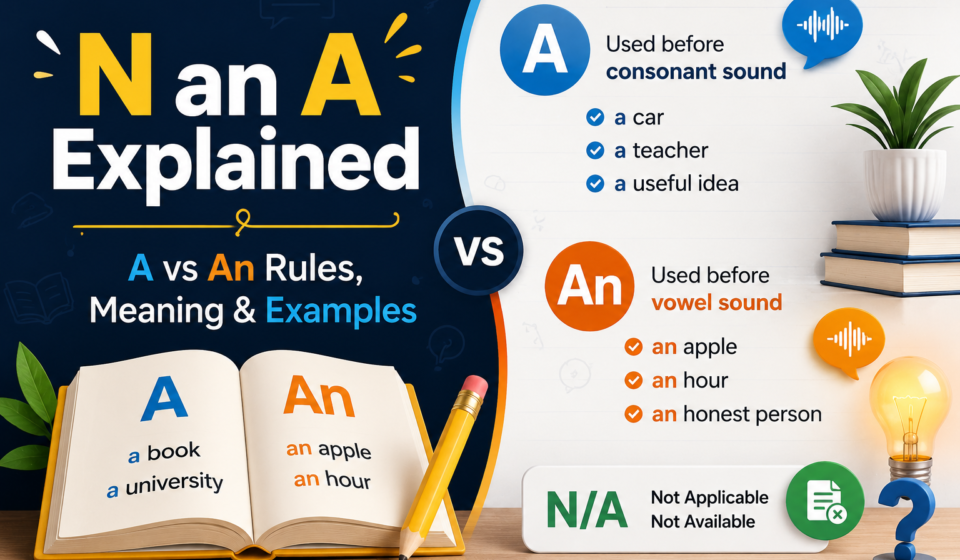

Learn what “n an a” means, understand a vs an grammar rules, pronunciation, examples, and N/A meaning in this clear 2026 guide.
There is also another common term that looks similar: N/A, which is normally used as an abbreviation for “not applicable” or, in some contexts, “not available.” Understanding the difference between these expressions makes it much easier to interpret forms, documents, sentences, and everyday English.
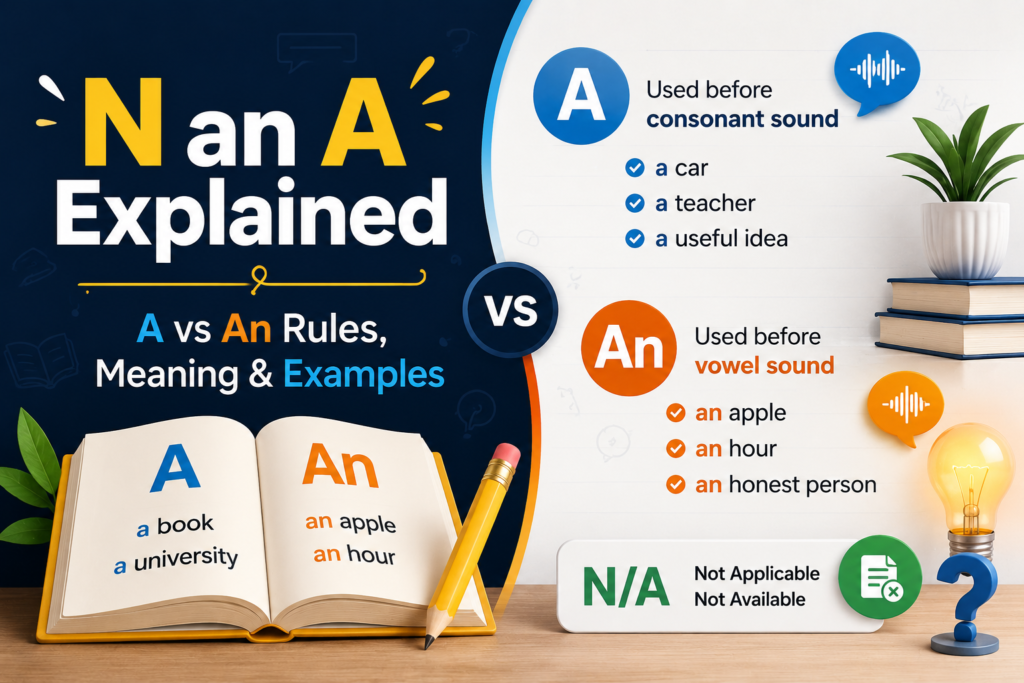
This guide explains the topic in straightforward language, with practical examples you can use in real writing.
What Does “N an A” Mean?
The phrase “n an a” is not a standard grammatical term by itself. In search queries, people may use it when looking for information about “a” and “an,” the two indefinite articles in English.
In grammar, a and an are used before singular countable nouns when the person or thing being mentioned is not specific. Cambridge describes these as the English indefinite articles.
For example:
a book
a teacher
an apple
an umbrella
The important point is that the choice between a and an is generally determined by the sound at the beginning of the following word.
When Should You Use “A”?
Use a before a word that begins with a consonant sound.
Examples include:
a car
a house
a student
a university
a European country
a useful idea
Notice something interesting about university and useful. Both begin with the letter u, but the initial sound is similar to “yoo,” which is a consonant sound. Therefore, we say a university, not “an university.”
This is why simply looking at the first letter can sometimes lead to the wrong answer.
Merriam-Webster explains that the sound, rather than the written letter, determines whether a or an is appropriate.
When Should You Use “An”?
Use an before a word that begins with a vowel sound.
Common examples include:
an apple
an orange
an idea
an employee
an accident
an umbrella
The same principle applies when a word begins with a consonant letter but is pronounced with a vowel sound.
For example:
an hour
an honest person
an honor
The letter h appears at the beginning of these words, but the initial h is not pronounced in the standard pronunciation. The result is a vowel sound, so an is used.
A vs. An: The Simple Rule
The easiest way to remember the rule is to listen to the word rather than look at its first letter.
If the word begins with a consonant sound, use a.
If it begins with a vowel sound, use an.
This produces examples such as:
a dog
a university
a one-time event
but:
an apple
an hour
an FBI agent
The last example is particularly useful because FBI begins with the letter F but is pronounced “eff.” Since “eff” begins with a vowel sound, the correct phrase is an FBI agent. Merriam-Webster specifically notes that the same sound-based principle applies to acronyms and initialisms.
Why “A University” Is Correct
One of the most common mistakes involves words beginning with u.
Many learners assume that every word beginning with a vowel letter must use an. That is not the rule.
Consider:
a university
a uniform
a user
a useful tool
Each begins with a sound similar to “yoo.” That opening sound functions like a consonant sound in this context.
By contrast:
an umbrella
an uncle
an unusual situation
These begin with vowel sounds, so an is appropriate.
The difference becomes much easier to understand once you say the phrase aloud.
A and An With Acronyms
Acronyms and initialisms can make this rule seem complicated, but pronunciation still provides the answer.
Consider:
an MBA
an MRI
an FBI investigation
an HTML document
These use an because the spoken names of the first letters begin with vowel sounds.
Now compare:
a NASA scientist
a CEO
a URL
a USB device
These use a when the acronym or initialism begins with a consonant sound when spoken.
The visual appearance of the abbreviation does not determine the article. Its pronunciation does.
What Is N/A?
Although “n an a” and N/A look similar when typed without punctuation, they represent a different concept.
N/A is commonly used as a written abbreviation for “not applicable.” It can indicate that a question, field, or category does not apply to a particular person or situation. Cambridge also records “not available” as a business use of N/A when information cannot be provided.
For example, imagine a form asking:
Middle name: ______
If a person does not have a middle name and the form requires an entry, they might enter N/A, depending on the instructions.
In another context, a table might show:
Product price: N/A
Here, N/A could mean that the price is currently unavailable.
The exact meaning depends on context.
N/A Does Not Mean “A and An”
It is important not to confuse N/A with the grammatical pair a and an.
They serve completely different purposes.
A / an are indefinite articles used in English sentences.
N/A is an abbreviation used to communicate that something is not applicable or, in some contexts, unavailable.
For example:
She bought an apple.
Here, an is an indefinite article.
Previous employment: N/A
Here, N/A is a form entry indicating that the field does not apply or that the requested information is unavailable.
Keeping these two uses separate prevents a lot of unnecessary confusion.
Common Mistakes With A and An
One frequent mistake is choosing an article according to spelling alone.
For example:
Incorrect: an university
Correct: a university
Another common mistake is doing the opposite with silent letters:
Incorrect: a hour
Correct: an hour
People can also become confused by words such as historic. Usage can vary depending on pronunciation and style, and Merriam-Webster notes that both a historic and an historic can be encountered, particularly because pronunciation and historical usage have differed.
For modern American English, consistency with the pronunciation you actually use is a practical approach.
How to Choose the Correct Article Quickly
When you’re unsure whether to use a or an, say the following word out loud.
Don’t focus only on its first written letter. Listen to the first sound.
If you hear a consonant sound, choose a.
If you hear a vowel sound, choose an.
For example:
a house → “h” is pronounced
an hour → “h” is silent
a university → “yoo” sound
an umbrella → vowel sound
a European trip → “yoo” sound
an American trip → vowel sound
This simple technique works in most everyday situations.
Why Correct Article Usage Matters
Using the correct indefinite article may seem like a minor detail, but it makes writing sound more natural and polished. In professional emails, academic work, websites, applications, and everyday communication, small grammar choices contribute to overall clarity.
Native speakers generally make these decisions automatically because they have developed an intuitive sense of English pronunciation. English learners can achieve the same result through repeated exposure and practice.
Instead of memorizing hundreds of individual words, learning the underlying sound rule is more useful.
Frequently Asked Questions
Is “n an a” a grammar term?
No. “n an a” is not a standard grammatical term. It may appear as a search query from someone looking for information about a and an, while N/A is a separate abbreviation with its own meaning.
What is the difference between A and An?
Both are indefinite articles. A is generally used before a consonant sound, while an is used before a vowel sound.
Is it “a university” or “an university”?
The correct form is “a university” because university begins with a “yoo” sound, which is a consonant sound.
Is it “a hour” or “an hour”?
The standard form is “an hour” because the h in hour is silent and the word begins with a vowel sound.
What does N/A mean on a form?
N/A commonly means “not applicable.” It can indicate that a particular question or field does not apply to the person completing the form. In business contexts, it can also mean “not available.”
Final Takeaway
If your search for “n an a” is about choosing between a and an, the key is surprisingly simple: listen to the sound, not just the first letter. Use a before a consonant sound and an before a vowel sound.
At the same time, remember that N/A is a different abbreviation, most commonly meaning “not applicable” and sometimes “not available.” Understanding the distinction makes both everyday writing and form-filling much easier.
English grammar becomes far less confusing when you learn the principle behind the rule instead of memorizing isolated examples. Once you start paying attention to pronunciation, choosing between a and an becomes almost automatic.