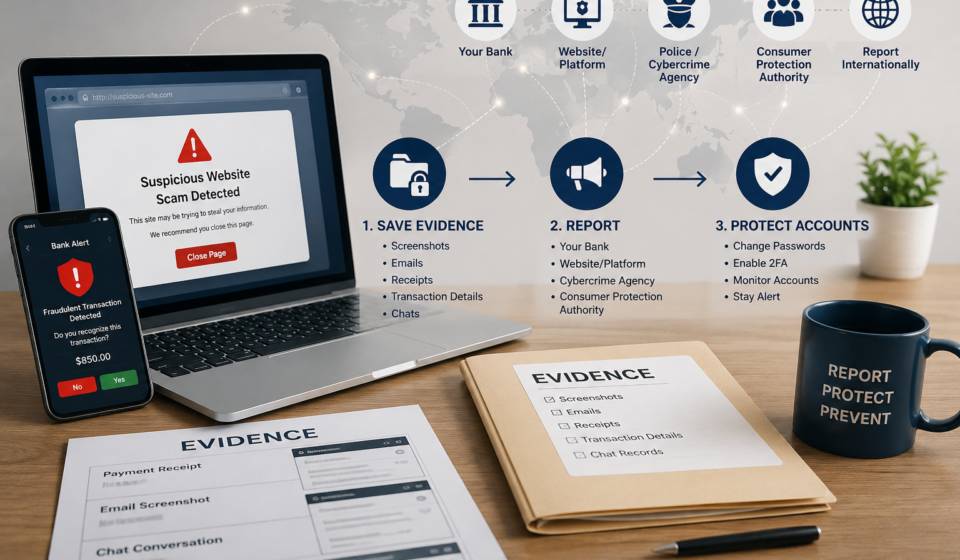

So you think you’ve been scammed. Take a breath — and whatever you do, don’t start deleting messages, screenshots, or emails. That “evidence” you want to erase because it’s embarrassing is actually the thing that gives you the best shot at fixing this.
Scams show up everywhere now: fake online stores, dodgy job offers, romance scams on dating apps, investment “opportunities” in a DM, phishing texts pretending to be your bank. The details change, but what you do in the first hour or two matters more than almost anything else.
Here’s the short version: save what you have, lock down your accounts, call your bank, and file a report. Below is exactly how to do each of those, plus what to expect afterward.
The 7 Things to Do Right Now
- Stop talking to the scammer. No more messages, no more “just one more payment to unlock it,” nothing.
- Save everything. Screenshots, emails, texts, links, receipts, usernames — grab it all before it disappears.
- Call your bank or payment provider. Tell them plainly: “I think this payment was fraud.” Ask what they can do.
- Lock down your accounts. Change any password the scammer might know, and switch on two-factor authentication.
- Report it to the platform. Flag the fake profile, listing, or message on whatever site or app it came from.
- File an official report. Use your country’s fraud or cybercrime reporting service.
- Stay alert afterward. Scam victims are frequently targeted a second time by fake “recovery agents.”
If you only remember one thing from this list, make it this: preserve the evidence before you do anything else. Scammers often vanish or delete their accounts the moment they sense trouble, and once that happens, proving what occurred gets a lot harder.
Where Do You Actually Report a Scam?
Here’s the annoying truth: there’s no single global website where you file a report and it’s handled. Where you go depends on your country and what type of scam it was — and often you’ll need to report it in more than one place.
Start with your country’s official cybercrime or fraud agency. A few examples:
- United States — FBI Internet Crime Complaint Center (IC3)
- United Kingdom — Action Fraud
- Canada — Canadian Anti-Fraud Centre
- Australia — ReportCyber and Scamwatch
- India — National Cyber Crime Reporting Portal
- Pakistan — National Cyber Crime Investigation Agency (NCCIA)
If your country isn’t in that list, search for your government’s official fraud or cybercrime reporting site directly. One warning: be wary of third-party sites that charge a fee just to “forward” your complaint to authorities — that’s often a scam layered on top of a scam.
Also report it to the platform where it happened. If the scam ran through a marketplace, social network, dating app, or messaging service, use their built-in reporting tools too. Most platforms let you flag:
- Fake profiles or impersonation accounts
- Fraudulent listings or ads
- Phishing messages
- Fake businesses or storefronts
- Suspicious payment requests
Reporting the account doesn’t just help you — it can stop the same scammer from hitting the next person.
Building Your Evidence File
You don’t need to play detective. Your only job is to hold onto what already happened. Before you file anything, gather:
- The full website URL (not just the name)
- Screenshots of the offer, chat, or payment page
- Emails and text messages
- Social media profiles, usernames, and phone numbers
- Payment receipts, transaction IDs, and order numbers
- Cryptocurrency transaction hashes, if that’s how you paid
One important note: don’t go back to the scam site and enter more personal information just to “gather proof.” Screenshots are enough — you don’t need to re-expose yourself.
If You’ve Already Sent Money
This is the part that matters most, so act on it first.
Call your bank, card issuer, payment app, or crypto exchange as soon as you can. Say it plainly: “I believe this transaction is connected to fraud.” Then ask what’s available to you — a dispute, a chargeback, a payment cancellation, a card replacement, or an account security review. What’s actually possible depends heavily on how you paid and how fast you spoke up, so don’t wait around hoping the situation resolves itself.
If the Scammer Got Your Password
Change it immediately — and if you’ve reused that password anywhere else, change those too. Then:
- Turn on two-factor authentication
- Check your recent login activity
- Remove any devices you don’t recognize
- Review your account recovery settings
- Watch for transactions you didn’t make
And a rule worth tattooing on your brain: never hand over a one-time verification code to someone who calls or messages claiming to be from your bank. Real banks don’t ask for that code.
Writing Your Report (You Don’t Need Legal Language)
A good fraud report is just a clear timeline. What happened, when, who contacted you, what you lost, and what proof you have. Something like this works fine:
March 4 — Received a message from an account claiming to be an online store. March 5 — They sent a link and offered a discounted product. March 5 — I paid $250 through a payment app. March 6 — The seller stopped replying. March 7 — The website went offline. Evidence: chat screenshots, the website URL, my payment receipt, the seller’s profile.
Stick to facts. If you’re not sure who the scammer really is, don’t guess in the report — just describe what happened.
Didn’t Lose Money? You Can Still Report It
Yes, absolutely. Phishing emails, fake job ads, suspicious “investment” pitches, and impersonation accounts are all worth reporting even if you never paid a cent. These reports help investigators spot patterns and catch repeat offenders before they scam someone who does lose money.
Will You Get Your Money Back?
Maybe — there’s no guarantee either way. It really comes down to:
- How you paid (cards and bank transfers often have more protection than crypto or gift cards)
- How quickly you reported it
- Whether the payment can technically be reversed
- Whether the recipient can be traced
- The specific policies of your bank or payment provider
Whatever the method, the advice is the same: contact your provider immediately and ask specifically about their fraud or dispute process.
Watch for the “recovery agent” scam
Here’s a cruel twist that catches a lot of people off guard: after you’ve been scammed once, someone else may contact you claiming they can get your money back — for a “recovery fee,” a “processing fee,” or a “verification payment.” This is very often just the same playbook running a second time on an already-vulnerable target. Verify independently before paying anyone for “recovery services.”
What Happens After You File a Report?
Don’t expect a phone call the next day. Depending on the country and agency, your report typically gets reviewed, cross-referenced against other complaints, and used to identify broader fraud patterns — sometimes it gets passed to another agency entirely. Hang on to your complaint number, confirmation email, and original evidence; you may need them later.
Reporting a Fake Website
If you stumble on a website you suspect is a scam:
- Save the URL and take screenshots first.
- Report it to the relevant platform, hosting provider, domain registrar, or a security service like Google Safe Browsing.
- File a report with your country’s fraud or consumer-protection authority.
And don’t try to take matters into your own hands by attempting to hack or take down the site — leave that to the people whose job it is.
Things You Should Never Hand Over
No matter how convincing the person on the other end sounds, never share:
- Passwords or PINs
- One-time verification codes
- Full card numbers
- Banking login details
- Security question answers
A scammer knowing your name, phone number, or address doesn’t make them legitimate — that information is often just publicly available or leaked from an unrelated breach.
Keep Watching Afterward
Reporting the scam isn’t the finish line. For the next few weeks, keep an eye on your bank accounts, credit card activity, email, social media, and any crypto wallets involved. If something looks off — an unexpected login, a password-reset email you didn’t request — act on it right away instead of waiting to see if it’s nothing.
The Simple Formula
STOP → SAVE → SECURE → CONTACT → REPORT → MONITOR
Stop talking to the scammer. Save your evidence. Secure your accounts. Contact your bank. Report the scam. Monitor what happens next.
Final Thoughts
Getting scammed is humiliating, and it’s easy to freeze up because you’re not sure what to do first. You don’t need to have it all figured out before you act — just start with the basics: save your evidence, lock your accounts, call your bank, and file your report. The exact process differs by country, but this framework holds up no matter where you are.
And one rule worth remembering above all: never send more money to anyone promising to recover what you already lost, unless you’ve independently verified exactly who they are. A scam can end after one payment — or it can keep going if you let your guard down twice.
Frequently Asked Questions
What’s the best way to report online fraud? Save your evidence, contact your bank or payment provider if you lost money, and file a report with your country’s official fraud or cybercrime authority.
Can I get my money back after being scammed online? It’s possible but not guaranteed. Contact your bank or payment provider right away and ask specifically about their fraud or dispute process.
How do I get a scam website shut down? Save the URL and evidence, then report it to the hosting provider, domain registrar, relevant platform, or a security service. Never try to hack or attack the site yourself.
What should I never say to a scammer? Never share passwords, PINs, verification codes, or banking details. Once you spot the scam, stop talking and report it.
Can I report a scam even if I didn’t lose money? Yes — attempted scams are still worth reporting, since they can help authorities spot larger patterns before someone else gets hurt.
What evidence should I collect after an online scam? Screenshots, emails, texts, URLs, usernames, phone numbers, payment receipts, transaction records, and any ads or listings involved.
Should I contact my bank after being scammed? Yes, as soon as possible — especially if you sent money or think your financial details were exposed.
What if the scammer contacts me again? Stop responding and don’t send more money. Be extra cautious of anyone offering to “recover” your stolen funds for a fee — it’s frequently a second scam.
A clear, step-by-step guide to reporting online scams, protecting your accounts, and knowing where to file a fraud report in your country.