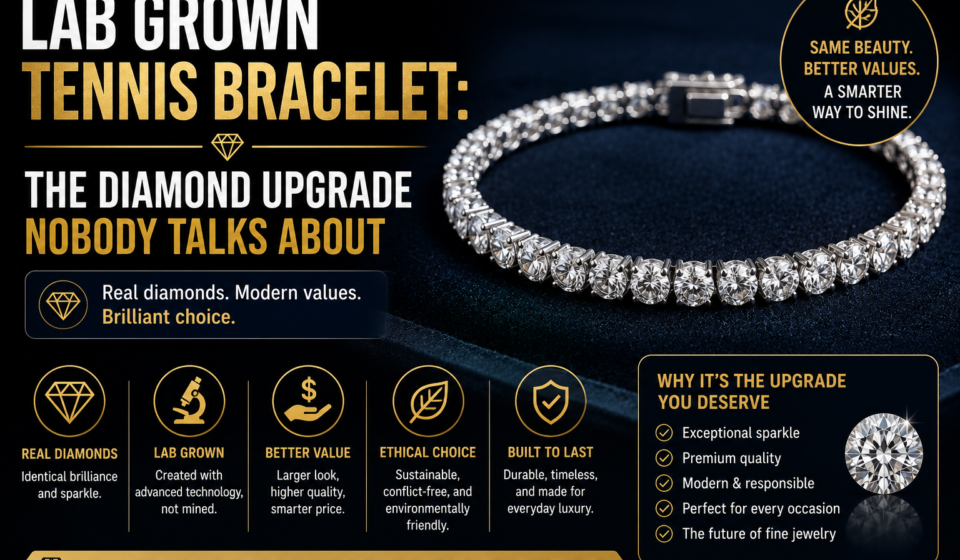

A synthetic tennis bracelet has been quietly becoming one of the best expensive jewelry purchases one could make in 2026, once you’ve mastered the math that go into it you’ll understand the reasons. The same dazzling shine that was once an investment of five figures for the natural stones is affordable, without sacrificing sparkle and durability or the classic design that has been a tennis-related fashion staple since the 1980s. This guide will explain the exact features of a lab grown tennis bracelet looks like and how it compares to natural diamonds as well as what the real-world pricing appears at across various carat weights and the best way to select an item that will last for many years of wear.
What Is a Lab Grown Tennis Bracelet, Exactly
A tennis bracelet that is grown in a lab is a small elastic bracelet constructed from a continuous row of separately set identically cut diamonds that move effortlessly around the wrist made of diamonds that are that are grown in a controlled laboratory instead of being mined out of the ground. The most distinctive visual aspect is exactly the same as that of the diamonds that are naturally found in it that is an uninterrupted row of identical stones forming an unbroken sparkle instead of an individual central point.
The reason that the lab-grown variant different comes down to the source, not just aesthetics or the quality. The lab-grown diamonds are chemically and optically similar to mined diamonds. They possess the exact same brilliance, hardness and fire. Furthermore, they’re not discernible to the naked eye, or conventional jewelry testing techniques without special equipment. The only difference that is significant is where the diamond was made and, for the buyer, how much it will cost.
Where the Tennis Bracelet Name Actually Comes From
The history of the name is interesting as it’s both fascinating and also because it explains the reason why the design is ever-popular. In the course of a game at the 1987 US Open, tennis champion Chris Evert’s diamond line-bracelet became loose and fell onto the court during play. She famously requested officials to stop play in order to find it. The moment was so well-covered by the media that the design, which was previously just referred to as an eternity or line bracelet bracelet, was forever linked to her. Four years later, the same continuous diamond design is still known as a tennis bracelet and is still among the top regularly searched for and bought types of the world of fine jewelry.
Why Lab Grown Diamonds Make So Much Sense for This Specific Style
Tennis bracelets come with a distinct need that diamonds from nature are unable to meet effectively They require a multitude of individual stones that are cut or colored and graded to appear like a uniform piece across the entire width of the bracelet instead of a single central stone. Finding a variety of natural diamonds that have genuinely uniform specifications is difficult and costly, given that natural stones differ in their appearance and even in the same grade.
Lab grown diamonds can solve this issue in a direct way. Since they are produced in controlled environments, producers can create numerous stones that are matched to the exact quality, clarity, and color cut specifications. This is precisely what a tennis bracelet requires to create an unbroken, continuous sparkle. This is one reason why techniques such as the dense pave setting which was traditionally expensive and difficult to find with diamonds that were natural and are now a common and affordable choice for laboratory-grown tennis bracelets of today.
The cost difference is significant and is consistent across the market. For the same quality, a lab-grown diamond is typically priced between 5 and 30 percent less than a natural stone, contingent on the particular retailer and the grading norm which is directly reflected in the value a consumer receives for their money or substantial savings with the identical specs, or an option to move up to a higher total carat weight, a better clarity and color or even a high-end metal setting with the same amount which would cost only a small fraction of natural diamonds.
Real 2026 Pricing: What to Expect at Different Carat Weights
Prices for lab-grown tennis bracelets differs by seller, choice of metal and diamond grading however the current market data for major jewelers provides a uniform image. The smaller pieces that range from 1 to 2 carat total weight usually start at the low hundreds to low thousands of dollars with a more subtle shine that’s ideal for casual wear or as a first bracelet purchase. Mid-range bracelets in between 4 and 5 carat weight range usually cost between two and five thousand dollars, depending on the color and clarity, metal type, and setting design.
As a comparison, a genuine diamond tennis bracelet with the same 5 carat value in 14k gold generally ranges from 12,000 to 22,000 dollars, depending on the grade which means that the lab grown equivalent typically has the same appearance and dimensions for about one-quarter of the cost or less. In the upper end jewelry that can be as large as 10 or 15 or even 25 carats are becoming accessible in lab-grown diamonds for prices which are hard to justify using natural stones for the majority of consumers, opening the market to a segment of jewelry previously restricted to the very few high-end buyers.
The Four Factors That Actually Drive Price
Knowing what factors drive the cost upwards or downwards helps to allocate your money on the things that are most important rather than paying for extra specifications which won’t show up in the final product.
Stone weight and carat weight are the two that have the most significant impact on the total cost as higher diamonds and a larger weights directly impact the cost of materials and the amount of labor. Color grade and clarity matter also, but less than many first-time buyers think because the tiny stones that make up the tennis bracelet, usually around 0.03 up to 0.20 carats, don’t exhibit minor inclusions or color like a larger center stone will. This makes them one of the most effective ways to save money, without loss of quality. the G color, VS2 clarity stone is really difficult to differentiate from a better quality stone in smaller dimensions.
The choice of metal affects the price and durability as 14k gold offers an excellent balance between affordability and durability for everyday wear, whereas platinum is a luxury but has a superior resistance to tarnishing and wear. Setting expertise rounds off the list since high-quality, precisely matched pave work demands more skillful work than simple prong settings even though the initial diamond price for lab-grown stones is relatively inexpensive.
Comparing Lab Grown with. Natural Diamond Tennis Bracelets
| Factor | Lab Grown | Natural |
|---|---|---|
| Visual appearance | Fire and brilliance are identical. | Similar brilliance and fire |
| Price (5ct, 14k gold) | Roughly $2,500-$5,000 | Roughly $12,000-$20,000 |
| Stones that match concordance | Excellent, made to specification | It is more expensive and difficult to achieve the exact match |
| Resale value | There is currently a limited secondary market | Stronger, more established resale market |
| Environmental/sourcing footprint | Production in the lower lab, which is controlled | Mining-dependent, variable based on the source |
| The best fit for | Everyday wear, the best quality and size for the money | Long-term investment and heirloom resale value |
Choosing the Right Cut and Setting Style
Round brilliant cut is the most sought-after choice for tennis bracelets. It is coveted by its light reflection, giving the classic, unmatched shine that most people envision as they envision the look. Princess cut provides an edgier, more geometric style with high brilliance, while offering an entirely different look on the wrist. Baguette and Emerald cuts swap some sparkle for a more sleek style that is more architectural and will appeal to those who want something that isn’t as traditional.
The style of setting affects both the appearance and practicality. Four prong settings allow maximum the amount of light that is reflected to each stone, giving it the most brilliant possible sparkle, but offering little physical protection for the edges of the stone compared to more closed settings. Pave settings, which are now readily accessible due to the lab-grown diamonds that are affordable, create an intensely packed, continuous shimmer that a lot of buyers find appealing, however it’s worth selecting a reliable jeweler to get this design as the quality of setting varies when using pave settings than more straightforward prong designs.
Getting the Fit Right
The fit is crucial for the tennis bracelet to ensure comfort as well as to protect yourself, as a loose-fitting bracelet is more likely to get caught on clothing or fall off undetected. The standard guideline that most jewelers advise is to measure your wrist at the point that is just above your wrist bone and adding two centimeters to the measurement to get an ideal fitting that feels comfortable and stays snug but not feeling too tight.
A brief list of security and fit checks worth conducting prior to deciding on a purchase:
- Make sure you measure your wrist precisely and ensure that the jeweler’s suggestion is in line with yours.
- You can test the clasp mechanism for yourself by making sure you close and open it several times.
- Check if a safety chain or a security chain with additional features is available
- Make sure the bracelet has certification in particular for weights with larger carats.
- Be sure to read the return and size policy prior to making the purchase
Caring for Your Lab Grown Tennis Bracelet
Lab grown diamonds possess the same hardness as natural diamonds, which means that the they have the same care requirements with respect to both. Placing the bracelet flat in a separate jewelry roll or pouch separated from other jewelry pieces, helps prevent prongs from getting caught and bent against more sharp or hard-wearing jewelry. Remove the bracelet prior to showering, swimming, or any other any physical activity that is intense protects the setting made of metal and closure mechanism. These are known to become the primary parts to wear out with regular usage.
A professional annual inspection is a must, regardless of how well you wear your piece from throughout the day, because an expert jeweler will be able to spot minor problems, such as a loosening prong or a clasp that is beginning to wear out, prior to turning into a lost gemstone or the bracelet comes loose suddenly. Cleaning using an easy brush and a moderate solution, instead of harsh household chemicals, can keep the item looking shiny without putting your jewelry at risk of damages to the setting over the course of time.
Is a Lab Grown Tennis Bracelet Actually Worth Buying
The majority of people that are interested in a synthetic tennis bracelet is the more feasible option in 2026. It will offer the same brilliance, durability and aesthetic appeal as an authentic diamond piece for just a fraction of the price. This gap in price doesn’t just provide savings, but also having access to a greater carat weight, superior clarity and color grading or premium metal options which are difficult to afford when using natural diamonds for many buyers.
The only real trade-off worth considering is resale value. Natural diamonds have a more solid, established secondary market that is crucial especially for those who see the purchase as a long-term investment as opposed to merely a thing to wear and appreciate. For all other buyers, especially buyers who are focusing on quality, size and value for every dollar, the lab-grown diamond is a very hard thing to defend on its own quality.
Common Mistakes Buyers Make When Shopping for a Tennis Bracelet
Some of the most common mistakes occur frequently in the first-time buyer and recognizing the potential pitfalls ahead of time could save you money as well as disappointment. One of the most frequent is spending too much on color and clarity grades that aren’t apparent due to the small size of the stones are, but that cash could be better spent on more weight in the total carat or a stronger metal setting. People who are looking for the natural stones in engagement rings usually apply the same mindset of grading to shopping for tennis bracelets but don’t realize that the rules differ in this case.
Another common mistake is not recognizing the significance of the clasp’s mechanism as a stunning bracelet that has weak or poorly designed clasp is one which will ultimately end up being lost. Test the clasp yourself or asking questions prior to purchasing online is a minor measure that can prevent a costly and common error. Some buyers do not even bother to check for proper certifications, particularly for larger, more costly pieces. This is important in both insurance and to ensure that the diamonds are in line with the specifications stated at the moment of purchase.
In addition, a lot of first-time purchasers choose a length of bracelet from a standard chart of sizing instead of taking a measurement of their own wrists directly which often results in a bracelet that’s uncomfortable tightly squeezable or loose enough that it can move around and catch things during the day. Spending a few extra minutes to properly measure your wrist prior to purchasing will avoid some of the more frequent and easily avoided disappointments when buying a tennis bracelet.
Final Thoughts
A tennis bracelet that is grown in a lab provides the exact classic design that’s been in fashion following Chris Evert’s iconic 1987 US Open moment, delivered with the same brilliance and strength as a genuine diamond with a price which makes higher-end, larger bracelets accessible instead of being only available to a select price segment. Knowing how carat weight, quality, clarity, color and setting design impact the price will allow you to put your money where it’s most needed instead of paying for specifications that will not appear in the finished piece. When you’re looking to purchase an initial tennis set or upgrading it to a striking piece with a more affordable prices and authentic diamond quality is what’s making lab-grown tennis bracelets towards the top of many wish lists for jewelry this year.
Frequently Asked Questions
What is the price an lab-grown platinum tennis ball costs? Pricing depends on the carat weight in total, but a 4-5 carat weight total lab grown tennis bracelet made of 14k gold is typically priced between 2,500 and five thousand dollars, in comparison to 12,000-20,000 dollars for a diamond with the same dimension and of the same quality.
Do you know the difference between a laboratory-grown as well as a natural, diamond-cut tennis bracelet? No, lab grown diamonds are chemically optically, and physically like natural diamonds. They are not discernible to the naked eye, or by conventional jewelry testing techniques which require special laboratory equipment to determine their source.
Which carat should I pick as my initial tennis bracelet? Many first-time buyers begin in between 1 and 3 carat total weight range to get a more subtle practical daily piece, whereas larger bracelets with 5 carats and more provide a more striking statement style ideal for buyers who desire greater visibility and sparkle.
Do lab-grown diamond tennis bracelets retain their worth as much like natural diamonds? Not currently. Natural diamonds are able to maintain a more robust and more established resale market, whereas lab grown diamonds are more restricted in their secondary market, which makes natural diamonds a better option when resale potential is an important factor.
How do I look for before buying a tennis ring on the internet? Confirm accurate wrist measurements by comparing the jeweler’s size guide, make sure the clasp has a secured closure mechanism, make sure the bracelet has proper certification, and read the seller’s return and resizing policies prior to you make your purchase.