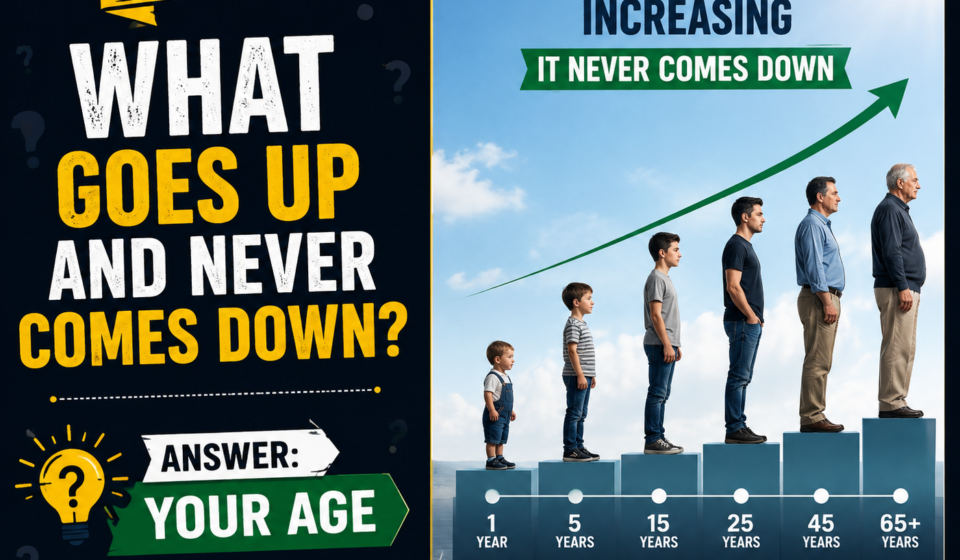
What Goes Up and Never Comes Down? The Answer, Meaning, and Story Behind the Classic Riddle

What Goes Up and Never Comes Down? The Answer, Meaning, and Story Behind the Classic RiddleSome riddles are difficult because they require complicated knowledge. Others are challenging because they encourage us to think about an ordinary idea from an unusual perspective. “What goes up and never comes down?” belongs to the second category. It is short, memorable, and deceptively simple, yet the answer often surprises people when they first hear it.
The answer is your age.
As time passes, a person’s age continues to increase. It can never move backward under the normal meaning of age. You may grow from one year old to five, then ten, twenty, thirty, and beyond. Although many things in life can rise and fall, your chronological age keeps moving in one direction.
This classic riddle is popular because it combines everyday experience with clever wordplay. The word “up” usually makes people imagine physical movement, such as a balloon rising into the sky, smoke climbing upward, or an elevator traveling to a higher floor. However, the riddle uses “up” in a figurative sense. Your age goes “up” every year, but it never comes back down.
The Answer: Your Age
The simplest answer to “What goes up and never comes down?” is age.
Every birthday marks another year of life. When someone celebrates their tenth birthday, their age has increased from nine to ten. The following year, it rises to eleven. This pattern continues throughout life.
For example:
- At birth, a baby begins life at age zero.
- After one year, the child is one year old.
- After five years, the child is five.
- After ten years, the child is ten.
- After eighteen years, the person is eighteen.
- After thirty years, the person is thirty.
- After fifty years, the person is fifty.
The number representing chronological age continues to increase as time passes.
That simple progression is what makes the riddle work so effectively. Nothing physically climbs upward, yet age is described as something that “goes up.”
Why Does the Riddle Feel Difficult?
The main reason this riddle can be confusing is the way the question is phrased.
When people hear “What goes up?”, their minds often search for objects that physically move upward. They might think about:
- Balloons
- Birds
- Airplanes
- Smoke
- Fire
- Rockets
- Elevators
- Kites
- Temperature
- Water in a fountain
Many of these things can go upward, but they can also come back down.
A balloon can fall. A bird can land. An airplane can descend. Smoke eventually disperses. A rocket can return to Earth. An elevator can travel downward. Even temperature can rise and later fall.
The riddle eliminates these possibilities with the second part: “never comes down.”
That phrase encourages the listener to stop thinking about physical objects and consider something abstract. Once the idea of age enters the discussion, the answer becomes obvious.
Age Is a Measurement of Time
To understand why age works as the answer, it helps to understand what age represents.
Age measures the amount of time that has passed since a person’s birth or another starting point. In everyday conversation, we normally express it in years.
If someone was born in 2000 and the current year is 2026, that person is approximately 25 or 26 years old, depending on whether their birthday has occurred.
The important point is that time keeps moving forward.
Because chronological age is tied to elapsed time, it generally increases as the years pass. You cannot return to being chronologically younger simply by wishing for it.
This is the clever foundation of the riddle.
Why “Up” Means Increase
The word “up” does not always describe physical direction.
English frequently uses “up” to describe an increase in quantity, level, value, or measurement.
For example, people say:
- Prices went up.
- Sales went up.
- The temperature went up.
- The company’s profits went up.
- His score went up.
- Her experience level went up.
In these examples, nothing necessarily moves upward physically. Instead, the numerical value increases.
The same principle applies to age. When someone says, “My age went up another year,” they are describing an increase rather than physical movement.
Therefore, the phrase “goes up” is a clever linguistic clue.
Why Age Never Comes Down
The second part of the riddle provides the decisive clue.
Your chronological age does not normally decrease.
A person may feel younger, look younger, become more energetic, or improve their physical condition, but their actual chronological age continues forward.
For instance, someone who is 40 might become fitter and healthier through exercise. They may improve their appearance and feel considerably younger. Nevertheless, their chronological age remains 40 until their next birthday, after which it becomes 41.
This distinction is important.
Biological condition can change, but chronological age continues to advance.
That is why age is such an appropriate answer.
The Riddle Is About Perspective
One of the most interesting aspects of this riddle is that it demonstrates how perspective influences problem-solving.
If the question were:
“What physically rises and never falls?”
the possible answers would be very limited.
But the actual question simply asks:
“What goes up and never comes down?”
The wording is broad enough to encourage creative interpretation.
The listener initially thinks about direction. The correct answer requires thinking about measurement and time instead.
This is a common technique in riddles. A good riddle often uses familiar words in an unexpected way. The challenge is not necessarily finding obscure information. Instead, the challenge is recognizing the intended meaning.
Why This Riddle Is Popular
The riddle has several qualities that make it easy to remember and share.
First, it is extremely short. Someone can ask it in a single sentence.
Second, the answer is based on a universal human experience. Everyone experiences the passage of time.
Third, the wording creates a misleading mental image. People naturally imagine something moving upward.
Finally, the answer creates an immediate moment of recognition. Once someone hears “your age,” the logic becomes clear.
These qualities make the riddle suitable for conversations, classroom activities, family games, social media posts, quizzes, and children’s entertainment.
Is Age the Only Possible Answer?
“Your age” is the classic and most widely recognized answer.
However, riddles can sometimes have alternative interpretations. Depending on the context, people may suggest concepts such as time or the number of years that have passed.
Still, age remains the strongest answer because it directly fits both parts of the question.
Time itself can be discussed in philosophical ways, but age is easier to connect with the idea of something numerically “going up.”
The riddle is therefore best understood as a wordplay question rather than a scientific statement.
The Difference Between Age and Height
Another interesting comparison involves human height.
When people are young, their height usually goes up as they grow. A child might grow from 100 centimeters to 120 centimeters and eventually become much taller.
However, height does not fit the riddle because it can stop increasing and may even decrease later in life.
Age is different.
Even after physical growth stops, chronological age continues increasing.
A person might stop getting taller at around adulthood, but they do not stop getting older.
This distinction helps explain why age is a better answer than height.
What About Money or Wealth?
Some people may answer the riddle with money because investments, savings, or income can increase. However, money does not satisfy the “never comes down” condition.
Financial values can rise and fall dramatically.
A person’s savings may increase during one period and decrease during another. A company’s stock price may rise and later decline. Income can change because of employment, business conditions, or economic circumstances.
Therefore, money is not as reliable an answer.
Age, on the other hand, provides a much more consistent relationship with time.
What About Temperature?
Temperature is another tempting answer.
People often say that the temperature is “going up.” During a hot day, temperatures may climb significantly.
However, temperature can also go down.
Morning temperatures can rise toward afternoon and then fall during the evening. Seasonal temperatures also fluctuate.
Consequently, temperature fails the second half of the riddle.
This demonstrates an important lesson: a possible answer must satisfy the entire question, not just one part of it.
What Makes a Good Riddle?
The “What goes up and never comes down?” riddle demonstrates several characteristics of effective riddles.
1. It Is Simple
The question uses ordinary vocabulary. There are no complicated technical terms.
2. It Is Misleading
The word “up” encourages the listener to think about physical movement.
3. It Has a Logical Answer
Once the answer is revealed, the reasoning is easy to understand.
4. It Is Universal
Everyone has an age, so the concept is familiar to virtually everyone.
5. It Encourages Critical Thinking
The listener must reconsider the meaning of the words rather than immediately accepting the first interpretation.
These characteristics help explain why the riddle has remained popular across generations.
A Lesson in Creative Thinking
Although this is a simple riddle, it teaches a valuable problem-solving technique: don’t always interpret a question literally.
When a problem seems obvious but none of the obvious answers work, consider whether a word has another meaning.
For this riddle, “up” means increase, not necessarily move toward the sky.
This approach can be useful beyond riddles. In education, business, writing, mathematics, and everyday decision-making, people frequently encounter situations where assumptions lead them in the wrong direction.
Creative thinking often begins by asking:
“Am I interpreting the question correctly?”
That small change in perspective can reveal an answer that was hidden in plain sight.
The Role of Time in the Riddle
Time is the central concept behind the answer.
Every moment that passes becomes part of the past. Days become weeks, weeks become months, and months become years.
As those years accumulate, chronological age increases.
Consider a simple timeline:
10 years → 11 years → 12 years → 13 years → 14 years → 15 years
The numbers move forward.
A person cannot make their chronological age become 13 again after turning 14. They may remember being 13, but they cannot reverse the actual passage of time.
That permanent forward movement is precisely what makes the riddle so clever.
Can Someone Become Younger?
There is an important distinction between feeling younger and actually becoming younger.
People can improve their fitness, change their lifestyle, adopt healthier habits, or develop a more youthful appearance. Modern technology and cosmetic treatments can also influence how someone looks.
However, these changes do not reverse chronological age.
A 50-year-old who feels energetic is still 50. A 60-year-old who looks remarkably youthful is still 60.
The riddle focuses specifically on chronological age rather than appearance, health, or emotional state.
Why Children Often Enjoy This Riddle
This riddle is especially suitable for children because it introduces abstract thinking through a familiar subject.
Children understand birthdays very well. They know that each birthday represents becoming another year older.
At the same time, the phrase “goes up” may initially make them imagine something physical.
The answer therefore creates a small but meaningful cognitive surprise.
Riddles like this can encourage children to:
- Listen carefully.
- Consider multiple meanings.
- Think creatively.
- Identify clues.
- Question assumptions.
- Explain their reasoning.
These are useful skills for learning and communication.
How to Use the Riddle in a Quiz
The question can also work well as a quick quiz or social media engagement post.
For example:
Question: What goes up and never comes down?
A. A balloon
B. Smoke
C. Your age
D. An elevator
The correct answer is C. Your age.
A multiple-choice format makes the question accessible to a wider audience while still preserving the element of surprise.
For a social media post, the answer can be hidden until the audience has had time to respond.
A Simple Explanation for Kids
If the riddle needs to be explained to a child, the answer can be presented very simply:
“The answer is your age. Every year, your age increases by one. You can be 8, then 9, then 10, but you never become younger in chronological age.”
This explanation is short enough for young readers while still explaining the logic.
A Deeper Meaning Behind the Riddle
Beyond the wordplay, the riddle can also encourage reflection on the passage of time.
Age is more than just a number. It represents experiences, memories, relationships, achievements, challenges, and personal growth.
Every year adds another chapter to a person’s life.
Although people sometimes worry about getting older, aging can also represent learning and development. With time comes experience, and experience can provide knowledge that cannot be gained instantly.
In this sense, the riddle can be viewed as a small reminder that time is always moving forward.
Frequently Asked Questions
What goes up and never comes down?
The classic answer is your age.
Why does age go up?
Age increases because it measures the amount of time that has passed since birth.
Can age ever go down?
Chronological age does not normally go down. A person can feel younger or look younger, but their actual age continues forward.
Is “time” also an answer?
Time can be considered a related interpretation, but age is the traditional answer to the riddle.
Why is the riddle tricky?
It is tricky because “up” sounds like physical movement, while the intended meaning is an increase in age.
Is this a mathematical riddle?
Not exactly. It uses numerical progression, but its main mechanism is language and wordplay.
Final Answer
The answer to “What goes up and never comes down?” is your age.
The cleverness of the riddle comes from the double meaning of the word “up.” Instead of describing physical movement, “up” means an increase in a number. Every birthday adds another year to a person’s chronological age, and that number continues moving forward.
The riddle may be short, but its lesson is surprisingly useful. It shows how changing perspective can transform a difficult question into an obvious answer. When the literal interpretation doesn’t work, looking for another meaning can reveal the solution.
Ultimately, your age goes up as time moves forward, and it never comes down. That simple observation is what gives this classic riddle its lasting appeal.