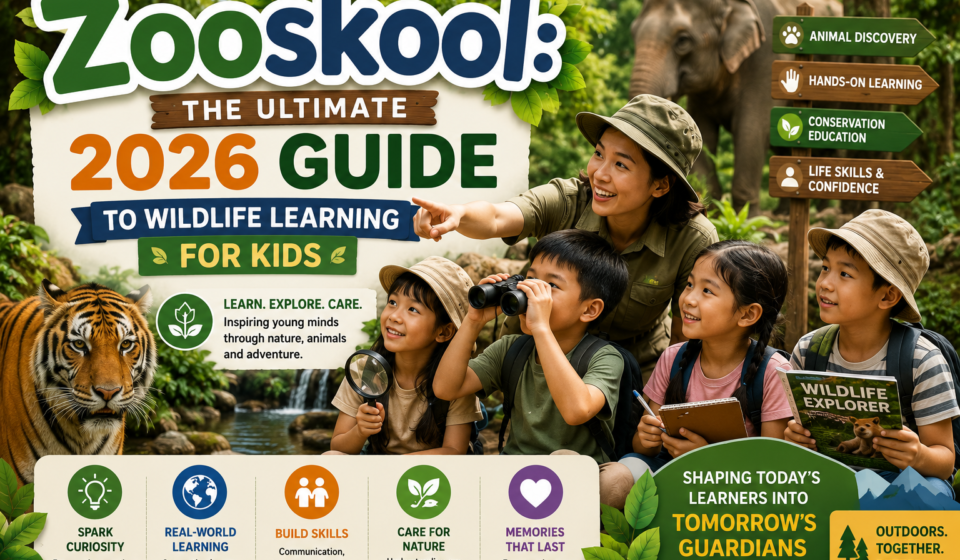

Zooskool is quickly becoming a sought-after search term for parents seeking more than the typical education with their child. Instead of focusing on screens, books, and worksheets, kids go into nature-based areas, watch animals, ask questions and learn from the world that surrounds them. The year 2026 is when this type of learning about wildlife is more crucial than ever before because most children spend a lot of time in the indoor environment and require more enriching learning opportunities that are more active and engaging to acquire knowledge. A positive experience at zooskool can inspire curiosity, confidence environmental awareness, and living skills, in a manner that is enjoyable as well as natural. It’s a memorable, enjoyable, and natural experience.
What Is Zooskool?
Zooskool is best described as a learning experience based on nature in which children are taught through outdoor exploration, wildlife as well as animal-related observation guided activities, as well as conservation-focused education. The term is frequently utilized by people looking for programs that are zoo-based as well as wildlife education camps, nature-based education sessions and outdoor learning that is based on animals for children.
A good Zooskool program is not just a way for children to see animals. It transforms the zoo and wildlife park into a classroom. Kids can observe the way animals move, eat or rest, communicate and adjust to their environment. They can also discover what biodiversity is as well as how conservation is a process and how every day actions can be used to protect our natural environment.
A good instance can be found at Mandai ZooSchool in Singapore, which claims to be Asia’s first ZooSchool and provides hands-on programs for children from the age of 3-12. It was founded by a collaboration that was formed between Mandai Wildlife Group and NTUC First Campus which combines educational programs for wildlife and the latest in early childhood learning.
This demonstrates why the concept of zooskool is more than the simple zoo trip. It’s now the intersection of outdoor play, education eco-friendly, responsible play, and the development of children.
Why Zooskool Matters in 2026
The children of today live in a society that is brimming with rapid information, entertainment on the internet and routines that are structured. These are good things however they restrict direct contact with the natural world. Children are familiar with animal names through videos before ever seeing the real-life animal behavior. They might recognize the tiger, elephant or an orangutan in a video but struggle to comprehend the effects of habitat loss as well as impacts on food chains, climate or the importance of conservation.
It is here that zooskool can become effective. It allows children to discover through their ears, eyes hands, hands, and feelings. Children who watch an animal caretaker explain routines for feeding may grasp the concept of responsibility better than reading the textbook. If a child can observe the way an animal adjusts to its surroundings may be able to see science as something that is alive, instead of something abstract.
Outdoor learning can also aid in the development of broader development. UNICEF observes that play in the outdoors is associated with improved physical, mental and emotional well-being as well as better learning. Studies on learning in outdoor environments have also found links between green spaces to positive effects on cognition, wellbeing as well as physical wellbeing.
The school for parents offers an ideal balance. It is educational but it doesn’t feel like a burdensome task. It’s enjoyable, but it also has a structure and a purpose. This is the reason why more families are searching for educational experiences that mix the thrill of adventure with an educational experience that is meaningful.
How a Zooskool Experience Usually Works
Zooskool is a well-designed experience that begins with curiosity. The children aren’t expected learn facts instantly. Instead, teachers guide them to spot patterns, ask questions and then connect their observations with easy explanations. For instance, instead of just stating that a giraffe is a neck that is long, a facilitator might inquire about how the neck is important to the giraffe’s survival and what it eats and what kind of body can be adapted to its environment.
A majority of Zooskool classes comprise guided strolls, animal observations and storytelling group challenges, environmental discussions, sensory play as well as simple hands-on games. Children in the younger years can learn by playing with sound, movement as well as textures, colours, and play that is imaginative. Children older than 5 may be interested in ecosystems, habitats, adaptation foods webs, species that are endangered and sustainable choices.
In Mandai ZooSchool, programmes are specifically designed for children ages 3-12 and are conducted within Singapore’s parks for wildlife. The official information on the program includes information on animal behavior conservation, life-skills, conservation outdoors, creativity as well as problem-solving and leadership.
This approach to learning is layered because children of various stages of development have different learning styles. A child in preschool may remember the excitement of walking along the trails of nature. A child in primary school might be able to recall why animals require secure habitats. Both of these experiences are beneficial however the method of teaching should be based on the child’s stage of development.
Zooskool Is More Than a Zoo Trip
A typical visit to the zoo can be fun, but it’s typically guided by the visitor. Families can walk from exhibit to exhibit and read the instructions, take pictures and observe feeding times If the timing is good. This kind of trip can be worthwhile however children could not learn more if there is no one who assists them in connecting what they are seeing with larger concepts.
Zooskool adds structure. It offers children a structured education path. It transforms casual observation into active observing. It helps youngsters understand the reasons why wildlife behaves in certain patterns, what habitats help to survive and how our choices impact the wildlife.
The differences are similar to going to a museum on your own as opposed to attending a well-taught workshop. Both are beneficial however, the experience that is guided typically helps children learn more learn more, retain more information and ask more pertinent questions. In a zooskool-like setting the teacher serves as a bridge between kid and his natural environment.
This is why zooskool supports learning at school without feeling like school. Science is made visible. Geography takes on a real-life dimension. Learning through teamwork is a way to build social skills. Children’s emotional development occurs when they develop empathy, patience, respect, and care for living things.
Key Benefits of Zooskool for Children
Zooskool supports children in several connected ways. It teaches skills, but also helps build confidence in social skills, self-reliance, and awareness of the environment. The best programs don’t focus on these results separately. Children can develop through their experiences.
| Area of Growth | How Zooskool Helps | Practical Example |
|---|---|---|
| Questions and curiosity | Children are taught to watch before coming up with answers. | The question is why some animals are active in the morning, while others lie in their beds |
| Science understanding | Abstract concepts are easier to comprehend in real-world situations | Learning adaptation through the comparison of claws, beaks tails, or eating habits |
| Communication skills | Group activities help children communicate concepts clearly | Making observations in the guided encounter with animals |
| Confidence | Outdoor challenges let children experience new things in a safe and secure manner. | Participating in a nature track, camp activity or keeper-led activity |
| Responsibility and empathy | Children are taught that animals require habitats and threats | Understanding the reasons why endangered species need protection |
| Physical development | Active outdoor learning and movement enrichment support active bodies | Exploring, walking balance, climbing and playing with sensory |
| Conservation awareness | Children’s choices are connected to environmental impacts | Understanding how water use, as well as habitat protection impact wildlife |
The value of zooskool’s program is not just in the things kids are able to remember. It’s also in the way that they start to think. They are taught that animals aren’t entertainment objects. They are living creatures that are connected to ecosystems and climate, food sources and human actions.
Why Parents Are Choosing Zooskool Programmes
The parents are increasingly conscious in their pursuit of enrichment. They are no longer looking for programs that just keep kids busy. They want to experience experiences that help develop solid skills, healthy confidence, and a wider perception on the universe. Zooskool fulfills this requirement as it integrates learning nature, movement and a sense of the need to achieve.
Another reason why parents love Zooskool is because it helps to reduce screen time that is passive and without making kids feel resentful. Children are naturally drawn by wildlife, and so learning about them is often exciting right from the very beginning. Children who are resistant to working on a task can happily be able to spend an entire hour asking questions about tracks of animals and nests, feathers, or even feeding habits.
Zooskool can be a good option for children who have different learning methods. Certain children learn best through listening. Others learn best through movement. Others require visual examples. Others need to feel or test, contrast, or investigate before a concept can be understood. Outdoor environments provide a variety of sensory experiences. NTUC First Campus notes that outdoor learning can help develop tactile skills, hands-on education as well as a greater relationship with the natural world.
A great alternative for busy families is zooskool. It is also a great option. It transforms weekends, school holidays or even enrichment time into something that is meaningful. Children have fun however, they also come back to their homes with tales, inquiries and new information.
What Children Can Learn at Zooskool
The knowledge gained from Zooskool programs can be quite vast. Parents may initially believe that the program is focused on animals. However, in reality, education about wildlife may be linked to geography, science and language, art ethics, teamwork and solving problems.
Children might be taught about the diets of animals and habitats, body characteristics and cycles of life as well as predator-prey relationships and ecosystems, weather, and conservation. They can also practice soft abilities like paying attention, waiting, watching attentively, respecting the boundaries, following safety guidelines and working in a team.
For instance, a lesson with reptiles can teach youngsters about body temperature and skin texture, movements camouflage, as well as the fear-based misconception. A bird-related lesson could spark discussion about feathers, migration nests as well as flight and the protection of habitats. Visits to the forest exhibit might result in discussions about water cycles, trees insects, threatened species.
The most appealing thing is that it is a feeling of being connected. The children aren’t jumping between unrelated facts to the next. They are learning how living systems interact. This kind of knowledge will be carried over for a long time since it is tied to actual sights, sounds and feelings.
Zooskool and Conservation Thinking
One of the main reasons to select zooskool is the ability to teach conservation in a manner that is kid-friendly. Children often hear terms like climate change pollution, extinction, or endangered animals, however these subjects can seem too large or intimidating. A thoughtful zooskool curriculum will explain them with love and a sense of hope.
Instead of putting children under a lot of pressure educators can make simple connections. Animals require water, food and shelter. They also require space and secure habitats. When forests decrease and oceans get polluted or humans waste resources, animals be harmed. If communities safeguard habitats, cut down on waste and encourage conservation, wildlife will have better chances of surviving.
Mandai’s educational materials and ZooSchool information put a strong emphasis on biodiversity conservation, wildlife animals’ behavior, as well as teaching children about the importance of preserving nature.
This is important because children who are interested in nature from an early age often become more thoughtful decision makers. They might become more cautious about plastics, more enthused about recycling and considerate when walking in nature and are more aware of the way their daily decisions affect the planet.
How Zooskool Builds Life Skills
A zooskool program that is well-established doesn’t just teach kids about animal species. It also assists them in practicing the life skills they need to master in natural settings. When kids play outdoors they need to be attentive to each other, turn around, follow instructions, control their excitement as well as be aware of risks and interact with other children.
These small moments might seem insignificant yet they are vital. Children who are quiet while watching an animal is practicing patience. Children who share binoculars are practicing co-operation. A child asking questions in the presence of others will help build confidence. A child who is learning to not hit glass or shout in front of animals is learning how to behave and respect others.
Learning outside can also increase the resilience of children. Children might feel exhausted, hot, uncomfortable or even overwhelmed by a new experience. If they are given the proper guidance they can learn to persevere, resolve minor problems, and believe in their abilities. These abilities are valuable far beyond the animal kingdom.
In this way the zooskool program works because it imparts knowledge through real-life scenarios. The children are not simply taught to take responsibility. They learn why it is important to be responsible.
Choosing the Right Zooskool Programme
Every wildlife-related program is exactly the identical. There are some that offer short, guided sessions. Some are camps for the holidays. Some are preschool experiences. Some are designed specifically for elementary school students. Some are focused more on playing while others concentrate more on conservation and science.
When choosing a zooskool school parents must be aware of some important points:
- Group size and age-appropriateness
- The duration of the program and the daily program schedule
- Safety rules and teacher experience
- Balance of outdoor and indoor activity
- The outcomes of learning and conservation are important to focus on.
The best program should be based on your kid’s age, their confidence level as well as their interests and. A child who is three years old may require smaller activities, more activity and more play with sensory. Ten-year-olds may appreciate more understanding of animals, survival techniques teams, and challenges to problem-solving.
Parents should also seek out programs that are led by qualified educators, not simply general entertainers. Learning in the wild is best when children are secure engaged, enthused, and guided to think.
Zooskool for Preschool Children
Zooskool for preschoolers should be fun, safe and awash with sensory. Children learn through repetition, movement with touch, sound and stories that are simple. They might not be able to remember complicated scientific terminology, but they do grasp basic concepts such as animals require food, animals need shelter and we need to be kind to living things.
A zooskool class for preschoolers could include animal-themed music as well as guided walks, basic games of matching, storytelling and activities that are soft to move as well as short moments of observation. The aim is not to overwhelm children with information. The objective is to instill curiosity.
This first wonder is important. If children are young and form positive memories of the natural world and animals, they will be most likely to be a connection to it later on. They start to view animals as living creatures on the planet, not only cartoon characters.
The preschool experience for parents may show the way children respond to group learning that is not in the traditional classroom. Some children become more expressive outdoors. Certain children are calmer. Some exhibit curiosity, which may not show up during desk-based tasks.
Zooskool for Primary School Children
Primary school children can handle deeper zooskool content. They are able to compare animal characteristics and understand basic ecosystems, debate wildlife threats, and participate in challenges for groups. They also can begin to consider causes and effects.
For this age group, zooskool may closely connect with the school curriculum. Science becomes more real-world when children can see actual examples of adaptation and habitats, diets and habitats camouflage and classification. Children’s language skills improve when they explain what they observe. Drawing can be done through sketches of wildlife or even habitats. Education is a value that comes through caring and empathy as well as responsibility.
The older children might also enjoy hidden-in-the-moment learning such as wildlife talks, keeper talks nature journaling, as well as conservation initiatives. These types of activities can make children feel confident and secure. The feeling of trust and confidence can help boost motivation.
A successful zooskool program for children in the primary grades should not be one that scolds them. It should encourage the children to think, inquire the world, talk about it, and make connections.
What Makes a High-Quality Zooskool Stand Out?
A top-quality Zooskool program cannot be judged solely on the amount of animals kids encounter. It’s assessed by the extent to which children are engaged. The most effective programs include clear learning objectives and trained teachers, secure environments, activities that are appropriate for children of all ages, and a firm commitment to animal welfare.
The welfare of animals is particularly important. Children must be taught they aren’t toys. The interactions should be peaceful, respectful and well-managed. Teachers who are good at establishing boundaries like keeping a safe distance with quiet voices and avoiding disturbing animals.
Another indication of high-quality is reflection. Children should take time to reflect on the things they observed and what they learnt. If they don’t reflect, their experience could be viewed as entertainment. Through reflection, it transforms into an education.
The best Zooskool programs integrate learning into everyday life. The children should leave with simple steps they can practice at home, for example recycling waste, taking care of the plants, respecting insects, preserving water, or learning about wildlife that lives in the area.
Zooskool and Family Learning
Zooskool doesn’t have to stop when the program is over. Parents can continue your child’s learning with simple discussions. Discuss with your children what has surprised them, what animal is the most recollected or what question they were asked or what they would like to know more about next.
These conversations aid children in understanding the experiences. They also help children understand that their observations are important. Parents do not have to be a specialist in wildlife. The curiosity of children is sufficient. If parents say “Let’s find out together,” they encourage continuous learning.
Families can also develop small habits of nature after an excursion to the zooskool. You can go to parks, take a bird walk and grow plants, cut down on single-use plastics, go through animal books, or write an easy nature journal. Small actions can help make the zooskool adventure regular part of life.
That’s where the value over time will be evident. One programme may spark interest. The repeated support of family members can turn this interest into concern knowledge, understanding, and responsible behaviors.
Zooskool in Singapore and the Rise of Wildlife Education
Singapore is an outstanding illustration of how education in wildlife can be integrated into family education. Singapore Zoo is known for its lush setting and an wide-ranging wildlife experiences. Mandai’s Singapore Zoo page states that the zoo houses over 4,200 species. It is a paradise-like natural habitat.
Mandai ZooSchool adds another layer to this ecosystem through organized learning opportunities for children. Its specially-designed learning environment as well as access to the wildlife parks helps children to learn in a different way than a traditional classroom environment.
The Straits Times reported that ZooSchool began in June 2025 to children aged 3-12 years old which includes animal encounters and outdoor adventure camps that are designed to help children develop a love of the natural world and life abilities. The report also outlined Mandai Wildlife Group’s goal to reach 50,000 kids annually in 2030.
This is indicative of a change in education. Teachers and parents are realizing that children require an experience that is direct and meaningful with nature. Zooskool is a perfect example of this as it integrates organized learning with animal encounters, adventure and conservation.
Practical Tips Before Sending Your Child to Zooskool
Preparation can help children enjoy zooskool more. Parents must explain the experience using simple language prior to the visit. Let your child know that they are welcome to stroll, look at wildlife, hear the educators and participate in group activities or ask questions. This can help reduce anxiety particularly for children who are young.
Comfort is another factor. Outdoor learning can be characterized by the elements of rain, heat walking, physical activity. Children must wear comfortable clothes and shoes that are suitable for their age. They should also carry sun protection, water as well as any other personal items that are based on guidelines of the program.
It can also be helpful to establish expectations for behavior of animals. Animals might not be in a state of activity. They may be secluded, rest or even move away. This is a fundamental part of wildlife education. Children can develop patience by recognizing that animals are able to follow their individual rhythms.
After the program, give your child a space to talk. Some children talk immediately. Others require more time. You can ask them questions later on, such as what they experienced and enjoyed, what they found interesting and what they’d prefer to do next time.
Common Mistakes Parents Should Avoid
A common error is to treat the zooskool as a class based on performance. Parents might ask “What did you learn?” too quickly, or expect children to remember facts. While information is important, sensory and emotional experience is important as well. A child might first recall the sounds of an animal or the excitement of a hike or the excitement of looking at something close. This is still being learned.
Another mistake is to choose an event solely based on cost or duration. The longer the session, it’s not necessarily better. A short, well-designed program could be more valuable than a full day of activities without a clear structure. The quality of the program is determined by the skill of the educator security, engagement, and clearly defined learning objectives.
Parents should be careful not to over-schedule. Zooskool is most effective when children are able to be fully engaged. If children are tired or hungry, or is rushing between activities it is possible that the lessons won’t succeed.
Also, try not to turn every minute into an opportunity to teach. Let children enjoy wonder. Sometimes the most effective learning starts with quiet fascination.
The Future of Zooskool
The future of zooskool is solid because it addresses a variety of current needs simultaneously. It encourages outdoor learning, helps to reduce the habit of passive screens, develops environmental awareness and gives children unforgettable real-world experiences. It also assists parents in finding activities that are both enjoyable and significant.
From 2026 onwards, families will look for programs that blend education and wellbeing. Zooskool is a good example of this since it allows children to be active, observe as well as feel, think and make connections. Zooskool isn’t solely about viewing animals. It’s about helping kids learn about life systems, appreciate the natural world, and view them as a an integral part of the future of our planet.
Since climate change the loss of biodiversity, climate change, and the wellbeing of children remain crucial subjects, education about wildlife will be more important. Kids who know about nature are more likely be concerned about the protection of it. Zooskool can be more than just a weekend pastime. It could be a first step towards becoming a responsible citizen.
Conclusion
Zooskool is a valuable method to teach children beyond screens, walls and standard classroom techniques. It combines nature education, outdoor exploration and conservation awareness. It also teaches useful life lessons in a manner that kids will enjoy and keep in mind. For parents, it provides an enticing mix of entertainment and value. For children, it provides the opportunity to ask questions to build confidence, study living things, and build respect for the natural world.
A quality zooskool experience will aid in learning about science as well as emotional growth as well as teamwork, interest, along with environmental responsibility. No matter if your child is experiencing animals for the first time, or an elementary school student who is ready to explore more conservation-related ideas Zooskool is a great way to transform an interest in nature into a deeper knowledge about the globe. In 2026, this type of education isn’t only beneficial. It’s essential.
FAQs About Zooskool
What exactly is Zooskool?
Zooskool is a educational experience that lets children gain knowledge by observing animals and outdoors activities, guided exploration and conservation education. Zooskool transforms the zoo or nature park in to a real classroom that helps children learn about ecosystems, habitats, and animals and the importance of caring for the environment.
What is the best age to start the zooskool?
Zooskool is a great option for children from the age of preschool until primary school if the program is planned properly. Mandai ZooSchool, for example has programs for children aged between 3 and 12. The younger children typically benefit from simple exploration, while older children are able to tackle more complex questions about conservation and science.
Zooskool is it only about animals?
No. Animals make up a large part of zooskool. However, the scope of learning is much broader. The children also learn about habitats and diversity, food chains collaboration, teamwork perseverance, problem-solving sustainability, and responsible behavior about living things.
What makes zooskool unique from an ordinary zoo trip?
Zoo visits are generally self-guided, whereas zooskool is based on learning objectives. Children are supervised by teachers and participate in various activities, look at animals more closely and then connect what they see to conservation, science and life skills.
Is zooskool worth it for children?
Zooskool is worth the cost when the program is secure, age-appropriate well-guided and focuses on engaging learning. It assists children in learning by experiencing real-world experiences, stimulates interest, encourages outdoor play and fosters respect for animals as well as the environment.